
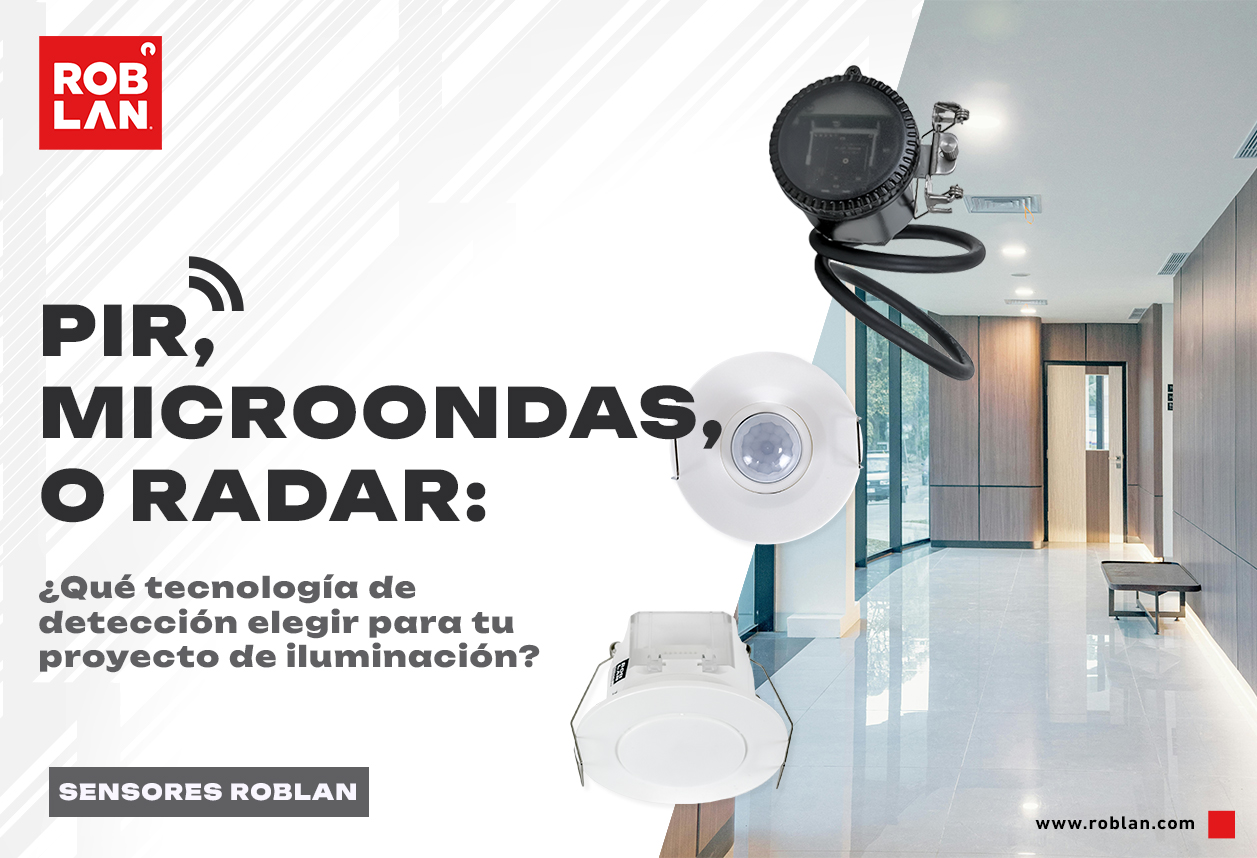
PIR, microwave or radar: which detection technology should you choose for your lighting project?
What is the difference between a PIR sensor, a microwave sensor and a radar sensor?
Which detection technology is best for saving energy?
Which sensor detects people sitting or working without moving?
Which is the best sensor for humid or industrial spaces?
Which sensor generates fewer false detections?
Can sensors detect through walls or glass?
Which type of sensor is most recommended for offices, warehouses or bathrooms?
These are some of the most common questions when designing an efficient lighting control system. Although all sensors share the same objective: turning lighting on or off depending on the presence or movement of people or the ambient light levels.
The technology they use to detect that presence can make a big difference to the system’s performance.
Choosing the right sensor not only improves the user experience, but can also significantly reduce energy consumption, prevent false activations and extend the system’s service life.
In this article, we analyse the three most widely used detection technologies today: PIR, microwave and radar.
PIR sensor (Passive Infrared): the most widely used technology
PIR sensors work by detecting thermal changes within their field of view. Instead of detecting physical movement directly, they identify variations in the infrared radiation emitted by the human body.
When a person enters the detection area, the sensor detects a change in the thermal pattern and activates the lighting.
Practical example
A person enters an office or walks down a corridor: the sensor detects movement and turns on the light.
However, if that same person remains seated for a long period working at a computer, the sensor may stop detecting activity and switch the lighting off.
Advantages of PIR sensors
- Low cost.
- Very stable and reliable technology.
- Low rate of false detections.
- They do not detect through walls or building elements, providing very precise control of the monitored area.
- Easy installation.
Disadvantages of PIR sensors
- They do not detect static presence.
- Their performance may be affected by high ambient temperatures.
- They are less effective in spaces with very high ceilings.
Where to install PIR sensors?
PIR sensors are an excellent option for:
- Bathrooms and toilets.
- Corridors.
- Offices with frequent foot traffic.
- Changing rooms.
- Small warehouses.
- Occasionally used rooms.
Microwave sensors: greater range and coverage
Microwave sensors use a completely different technology. Instead of detecting heat, they emit electromagnetic waves and analyse the return of these signals using the well-known Doppler effect.
When an object or person moves within the coverage area, the return pattern changes and the sensor activates the lighting.
Practical example
A person walking through a warehouse will be detected easily.
However, other moving elements can also trigger the sensor, such as an automatic door, moving machinery or certain structural vibrations.
Advantages of microwave sensors
- Greater detection range.
- They work perfectly in complete darkness.
- They do not depend on body temperature.
- Very suitable for installations with high ceilings.
- Large coverage areas.
Disadvantages of microwave sensors
- They can detect through glass, plastic or lightweight partitions.
- Higher likelihood of false activations.
- Lower ability to distinguish between human presence and other movements.
Where to install microwave sensors?
They are especially recommended for:
- Logistics warehouses.
- Long corridors.
- Industrial buildings.
- Covered car parks.
- Installations with High Bay luminaires.
- Loading and unloading areas.
Radar sensors (mmWave): the evolution of presence detection
Radar technology currently represents the most advanced level in detection systems for lighting.
Although it shares certain principles with microwave sensors, its analysis capability is far more sophisticated. It not only detects movement, but also imperceptible micro-movements such as breathing or small body gestures.
For this reason, it is referred to as true presence detection.
Practical example
A person sitting in a meeting, working in front of a screen or reading documents may remain still for long periods of time.
Whereas a PIR sensor might stop detecting them, a radar sensor will continue to identify their presence thanks to small body movements and even breathing.
Advantages of radar sensors
- True presence detection.
- Ability to detect people who are almost motionless.
- Detection of micro-movements and breathing.
- Drastic reduction in unintended switch-offs.
- High precision.
- It does not depend on body heat.
Disadvantages of radar sensors
- Higher cost compared to other technologies.
- They require more precise configuration.
- If not adjusted correctly, they may detect a larger area than necessary.
Where to install radar sensors?
This technology is especially interesting for:
- Modern offices.
- Meeting rooms.
- Classrooms.
- Libraries.
- Healthcare centres.
- Workspaces where people remain seated for long periods.
Quick comparison: PIR vs Microwave vs Radar
| Feature | PIR | Microwave | Radar |
| Detects movement | Yes | Yes | Yes |
| Detects static presence | No | Limited | Yes |
| Detects breathing | No | No | Yes |
| Range | Medium | High | High |
| False detections | Very low | Medium | Very low |
| Cost | Low | Medium | High |
| Ideal for high ceilings | No | Yes | Yes |
| Efficiency in offices | Medium | Medium | Very high |
Which is the best sensor?
There is no universal sensor that is best for all applications.
The choice will always depend on the type of space, the installation height, the activity carried out and the level of precision required.
A bathroom or corridor can work perfectly with PIR technology. A logistics warehouse will probably achieve better results with microwave sensors. A meeting room or a modern office where true presence detection is required will clearly benefit from radar technology.
That is why it is essential to analyse each project individually before selecting a detection technology.
ROBLAN helps you choose the right technology
At ROBLAN, we have a technical and project department specialising in efficient lighting and control solutions, which can advise you on selecting the most suitable sensor for each application.
In addition, we have a comprehensive sensor brochure where you can learn in depth about our full range of solutions, their detection technologies and the environments they have been designed for.
False activations: what things can affect them
Integration with the control system
Before selecting a sensor, it is essential to verify its compatibility with the lighting system and the communication protocols used, such as DALI, KNX, Zigbee, Bluetooth Mesh or BMS.
Easy integration reduces installation time and facilitates maintenance.
Risk of false detections: how to minimise them
False activations are one of the most common problems in automatic lighting systems. In addition to reducing energy savings, they cause inconvenience and reduce user confidence in the installation.
The most common causes are:
- Air currents and air conditioning.
- Sudden temperature changes.
- Machinery or moving elements.
- Structural vibrations.
- Pets or wildlife.
- External traffic.
- Movement behind walls or glass.
- Each technology responds differently to these factors. PIR sensors are more sensitive to thermal variations, while microwave and radar sensors can detect movement through non-metallic materials.
Conclusion: smart detection is key to saving energy
Efficient lighting does not depend solely on using high-performance LED luminaires. The ability to correctly detect when a space is occupied is equally important to maximise energy savings.
The right detection technology helps reduce unnecessary consumption, increase user comfort and optimise the operation of any installation, whether it is an office, a warehouse, an industrial facility or a public building.
Choosing between PIR, microwave or radar is not simply a technological matter; it is a decision that directly influences the efficiency, functionality and profitability of the installation throughout its service life.
In any case, selecting the most suitable sensor will always depend on the needs of the installation and the operating criteria established by the client, with prior analysis being key to achieving maximum system performance.

